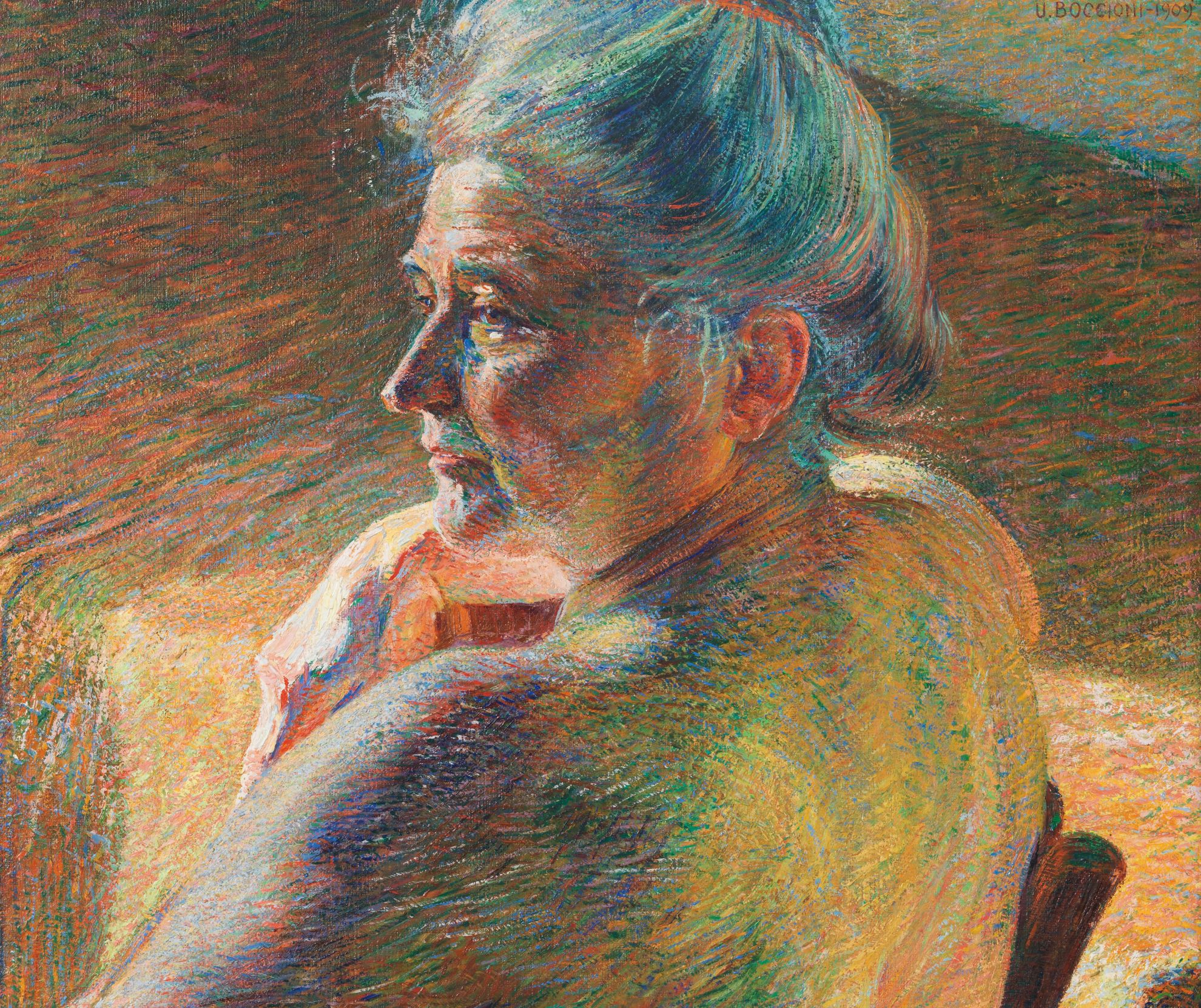
Umberto Boccioni
towards Futurist Liberation
07.08.2026 - 24.01.2027
LAC
Piazza Bernardino Luini 6,
6900 Lugano
MASI continues its series of exhibitions exploring the history of art in Ticino and its collections with a focus on Umberto Boccioni (Reggio Calabria, 1882 – Verona, 1916).
The exhibition offers an intimate and compelling insight into a decisive phase of Boccioni’s artistic development, revealing the tensions, uncertainties and contradictions that preceded his adherence to Futurism, of which he became one of the movement’s principal founders and theorists. “I’m searching, searching, searching, and not finding. Will I ever find?”, the artist wrote in his diary in March 1907. This question encapsulates the restlessness of those years and runs through the exhibition as a guiding thread.
From his earliest works of 1903–1904, through the crucial years of 1907–1909, to the formal innovations of 1911, the exhibition traces Boccioni’s constant pursuit of a new artistic language capable of expressing the modernity and dynamism of contemporary life.
The different stages of this artistic journey are illustrated through a group of fifteen works. A core selection of pre-Futurist paintings, donated to the City of Lugano by the heirs of Gabriele Chiattone, who supported and commissioned the artist during his Milan years, is presented alongside a carefully selected group of key works from the early Futurist period, on loan from important public and private collections.
Curated by Cristina Sonderegger
Umberto Boccioni (Reggio Calabria 1882 – Verona 1916) was one of the founders and the leading theorist of the Futurist movement in painting and sculpture.
After training as a journalist and poster designer, his encounter with Giacomo Balla in 1903 proved decisive for his development as a painter.
His early research led him to adopt the Divisionist technique. His ambition, as he stated in 1907, to “paint the new, the fruit of our industrial age” was fulfilled three years later with his adhesion to Futurism, of which he became one of the key figures.
Alongside painting, from 1912 he also pioneered in sculpture the theories of simultaneity and the interpenetration of forms.
In July 1915 he enlisted in the Lombard Battalion of Volunteer Cyclists, where he rejoined several exponents of Futurism.
Boccioni died on 16 August 1916 from injuries sustained in an accidental fall from a horse.
With the support of
Cover image
Umberto Boccioni, Nude from Behind (Backlight), 1909. Mart, Museo di arte moderna e contemporanea di Trento e Rovereto Collezione L.F.